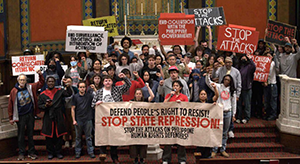
Filipino mass organizations, human rights advocates, and progressive allies across the United States have mobilized against federal surveillance and law enforcement actions targeting diaspora activists.
The movement centers on FBI surveillance, intimidation, and criminalization aimed at members of Filipino-American organizations—such as BAYAN USA, Malaya Movement USA, and Karapatan support networks—as well as their families in the US and the Philippines. They denounce increased home visits, questioning, and monitoring by federal agents, attributing these actions to intelligence-sharing between US agencies and the Philippine government’s National Task Force to End Local Communist Armed Conflict (NTF-ELCAC). Advocates argue that “red-tagging”—the Philippine state practice of labeling legal activists, journalists, and organizers as fronts for the banned Communist Party of the Philippines (CPP) and New People’s Army (NPA)—is effectively being imported into the US.
In response, communities launched the Defend People’s Right to Resist Campaign on October 27 at St. Mark’s Lutheran Church in Baltimore, Maryland. Led by BAYAN USA, the International Coalition for Human Rights in the Philippines (ICHRP)-US, Malaya Movement USA, and the International League of Peoples’ Struggles (ILPS)-US, organizers held a press conference and a protest caravan to the Philippine Embassy in Washington DC, alongside actions in Washington State and Northern California.
The campaign highlights specific incidents of harassment. Relatives of Christina Pasion, a Filipino-American activist arrested in the Philippines on July 30, report receiving intimidating calls and visits from the FBI and the US Embassy. Her brother, Gabe, stated: “The FBI intensified its harassment not only of our family; it is also targeting those who stand with the Filipino people... The collusion of the US and Philippine governments is their response to my sibling’s service.” Additionally, ICHRP-US leader Gordon Mutch was detained for four hours by US Customs and Border Protection at the Canadian border, where his electronic devices were confiscated without access to an attorney. Malaya USA leader Julie Jamora emphasized that these are not isolated events, but part of a coordinated strategy to suppress democratic movements.
This friction underscores a broader legal and political contradiction. In Deduro v. Vinoya (May 2024), the Philippine Supreme Court ruled that red-tagging and guilt by association directly threaten constitutional rights to life, liberty, and security.
Official US State Department reports regularly criticize red-tagging by Philippine authorities as an undemocratic tactic. However, when conducting domestic inquiries, US law enforcement frames its actions as lawful counter-terrorism rather than political red-tagging.
Diaspora organizations and civil liberties groups denounce that US agencies are being weaponized by foreign intelligence to suppress First Amendment-protected activism.