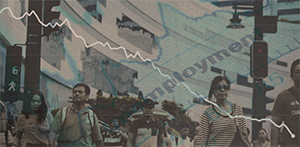
The research group IBON Foundation, in an article published November 7, 2026, warned that the Philippines is rapidly heading towards stagflation. The nation’s 3rd quarter economic growth of 2.1% is the slowest in 17 years and combines with the worst inflation and unemployment in the region to make the Philippines the economic laggard of Southeast Asia. IBON pointed out that the Marcos administration is mired in it’s business-as-usual approach that is worsening joblessness, eroding incomes and making the cost of living soar for millions of Filipinos.
The Philippine Statistics Authority (PSA) reported on November 9, that the actual GDP growth of 2.1% for the third quarter fell short of the initially estimated 2.8%. It was also lower than the 2.4% GDP growth in the second quarter. This marks the fifth consecutive quarter in which the country’s economy has slowed. IBON said third quarter growth was the slowest in the past 17 years, excluding the Covid-19 pandemic period. This comes alongside the region’s highest unemployment rate, at 5.4%, and its fastest rise in consumer prices, at 7.8%.
IBON revealed that the country’s economic performance is the poorest among its Southeast Asian neighbors. Based on latest available data, the Philippines has among the lowest GDP growth in the region at 2.1% compared to Brunei (0.02%), Thailand (1.9%), Malaysia (5.3%), Singapore (5.4%), Indonesia (5.5%) and Vietnam (10%).
Further, it said the Philippines has the highest unemployment rate at 5.4% compared to Indonesia (4.8%), Malaysia (2.9%), Vietnam (2.2%), Singapore (2%), and Thailand (0.9%); and the fastest inflation rate at 7.8% compared to Lao PDR (7.7%), Cambodia (5.3%), Vietnam (5.1%), Thailand (3.9%), Indonesia (3.2%), Singapore (2.2%) and Malaysia (1.8%).
The research group said this is because the economy is consumption-driven and services-heavy. The government’s economic policies are over-reliant on overseas remittances and BPOs, on real estate and utilities, and on foreign investment enclaves. Yet it neglects more important fundamental drivers like strong domestic agriculture and Filipino manufacturing, on the production side, and robust household spending from higher wages and other family incomes.
The PSA reported that agriculture’s consequent contribution to the country’s total GDP fell to 6.9%, its lowest since 1991. The manufacturing sector also declined, crawling at only 0.7% growth. The sharp drop in rice production (-17.8%) and corn production (-17.4%), alongside the shrinkage of the fisheries sector (-8.5%), dragged down agriculture.
Ang Bayan Ngayon, in its article on November 10, said that the Department of Agriculture blamed bad weather, the onset of El Niño, and the continued rising costs of fertilizers and fuel. “In truth, the reactionary state has long lacked a comprehensive plan and preparation for confronting disasters. It provides no meaningful support or subsidies. Instead of strengthening local production, the state is deliberately killing the sector by turning to large-scale food and agricultural product imports.”