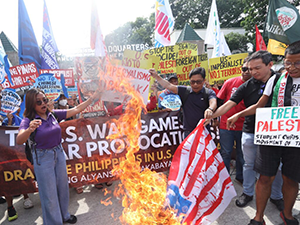
Together with the US, the use of the Philippines of successive “war games” as cover for counterrevolutionary operations marked by brutal violations of human rights was a factor in the Marcos regime’s failure to get a seat in the United Nation Security Council seat.
According to Ang Bayan, official publication of the CPP, contrary to claims that the recent war games were conducted for supposed “external defense,” these war exercises by the US, Philippines, Australia, Japan, New Zealand and Canada, actually carried out counterinsurgency operations in Filipino peasant and fisherfolk communities. This is a disguised direct involvement of US troops in the internal civil war in the Philippines.
Ang Bayan reported that after Balikatan 2026 which was conducted last May, the US immediately launched war games Salaknib, Kasangga, and Marine Exercise (MAREX). Salaknib 2026 in Luzon rehearsed moving military equipment between islands under the pretext of “archipelagic defense” and focused on jungle warfare and small unit tactics training under “real time” conditions. “Jungle combat training centers” were set up for this. Kasangga 2026-1 in Camarines Sur launched on May 26 used the coastal and mountainous areas of Pasacao, Balatan, San, Libmanan, and Ragay and intruded into communities and tightened restrictions on the movement and livelihoods of farmers and fisherfolk. MAREX 2026, meanwhile, is being conducted with the Philippine Marine Corps in Maguindanao del Norte, Mindanao, and focuses on jungle patrols outside Camp Iranun and artillery firing near populated areas in Datu Blah Sinsuat and Barira. The shelling terrorized residents.
“War games by the US have from the outset emphasized counterinsurgency operations. Before it became a multinational display of troops and weapons, Balikatan focused on “internal defense” or experimenting with tactics and equipment against the Bangsamoro armed movement and against the New People’s Army. Under its cover, the US staged large-scale hypocritical civil-military operations such as building schools, conducting medical missions, digging wells, and other schemes to win the people’s “hearts and minds” away from revolution,” Ang Bayan said.
According to Ang Bayan, these operations severely affected Filipinos with foreign troops encroaching on peasant and fishing communities, restricting residents’ movement, and barring them from their livelihoods. In Bicol, foreign troops were reportedly seen in Barangay Mainit, Pasacao and at least 20 other barangays. Soldiers set up checkpoints along the roads. In Mindanao, shelling and checkpoints on the roads have brought fear and disrupted residents’ movement. In Zambales, the “no sail zone” was imposed to make way for the war games and barred fisherfolk from their livelihood depriving more than 4,840 fisherfolk of their income in Subic alone. Aside from hunger, residents also complain about damaged corals and fish being driven away by the noise and pollution from the giant warships and missile launches, the CPP publication reported.
International and local human rights groups cited these continuous war exercises and warmongering led by the US, the brutal human rights record of Marcos Jr’s regime, and brazen corruption in the system of government, as among the reasons why the Philippines failed to secure a non-permanent seat on the United Nations Security Council.
Human rights groups emphasized that this is a victory for the campaign that exposed the regime’s crimes and violations of international humanitarian law. A seat on the UN Security Council could only embolden the US-Marcos regime to intensify repression against the poor and Filipinos fighting for their rights, human rights groups stressed.
“The UN Security Council is widely recognized as a compromised body, where the veto power of a handful of imperialist states routinely paralyzes any form of meaningful action to protect peace. However, even within this deeply discredited framework, Marcos Jr.’s bid for a non-permanent seat sends a profoundly wrong signal. It suggests that regimes actively complicit in militarization of communities and repression can be elevated as “credible” arbiters of international peace and security,” the NDFP International Office pointed out in a separate statement.