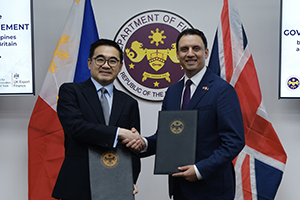
On October 5, Bagong Alyansang Makabayan (BAYAN)-UK released a statement urging President Marcos Jr. to recognize that “the Filipino people are not pawns for imperialist wars.” The group raised grave concerns over deepening economic and defense ties between Manila and London. These include a newly signed framework granting access to £5 billion (~₱419 billion) in UK Export Finance, as well as ongoing negotiations for a UK–Philippine Status of Visiting Forces Agreement (SOVFA).
The Department of National Defense (DND) confirmed that formal SOVFA negotiations began on August 27. Negotiating panel head Undersecretary Salvador Melchor Mison Jr. highlighted the growing defense partnership and praised London's support for the so-called “rules-based international order” under the 1982 UN Convention on the Law of the Sea (UNCLOS).
The Communist Party of the Philippines (CPP) strongly criticizes Visiting Forces Agreements (VFAs), deeming them unequal pacts that erode national sovereignty.
Ratified by the Philippine Senate in 1999 under Joseph Estrada, the US–Philippine VFA replaced the expired 1991 Military Bases Agreement. The CPP argues it transformed the entire archipelago into a de facto foreign military base.
While the Philippine Senate ratified the VFA as a binding treaty, the U.S. treats it merely as an executive agreement recognized under the Case-Zablocki Act.
US forces enjoy visa-free entry and tax exemptions on imported equipment and goods.
American personnel are exempt from automatic local judicial jurisdiction. High-profile offenses—such as the 2005 "Nicole" rape case and the 2014 murder of Jennifer Laude—highlight how the agreement shields foreign troops, housing convicted Americans in special designated facilities rather than local prisons.
The 2014 Enhanced Defense Cooperation Agreement (EDCA) expanded this framework, granting US forces access to nine "agreed locations" within Philippine military camps without requiring the constitutional two-thirds Senate approval.
Beyond the US, the Philippines has established similar agreements with Australia and Japan, with negotiations underway with New Zealand and the UK.
The CPP warns that these expanding pacts drag the nation into imperialist war provocations against China and heighten militarization in the South China Sea. Calling for demilitarization and a peaceful resolution to maritime disputes, the CPP emphasizes that a kinetic war between the US and China would be catastrophic for the Philippines.