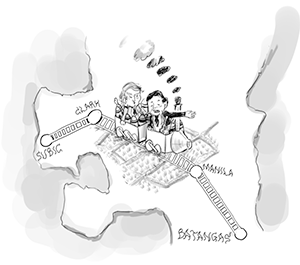
Protests erupted outside the Grand Hyatt Manila in Bonifacio Global City on September 10, where President Ferdinand Marcos Jr. attended the inaugural Luzon Economic Corridor (LEC) Investment Forum. Organized by Bagong Alyansang Makabayan (Bayan), hundreds demonstrated against the forum, calling it a sellout of Philippine sovereignty and national resources to American and Japanese capitalists.
Clashes with police and hotel guards left at least 27 protesters injured. Five paralegals were arrested and charged before being released on bail on September 12. Police subsequently threatened charges against youth leaders and Bayan officials.
The Marcos regime’s fascist response to the people’s opposition to imperialist destruction and plunder drew widespread condemnation.
Co-hosted by the U.S., Japan, and the Philippines, and sponsored by the U.S. Trade and Development Agency (USTDA), the forum gathered over 600 investors and officials to accelerate commercial partnerships in transport, energy, and tech supply chains.
The Communist Party of the Philippines (CPP) proclaimed that the corridor serves U.S. militarist and supply-chain ambitions. Key deals include energy initiatives, expanding Subic Drydock Corporation for warships, and deploying "AI-enhanced" Wi-Fi networks. U.S. plans also envision similar economic corridors across the Visayas and Mindanao.
A core component, the Pax Silica economic security zone, was rebranded as the Clark Advanced Manufacturing Park (CAMP) in Tarlac. While state officials declared that energy-heavy data centers and critical mineral processing facilities will be placed elsewhere—such as Batangas, Metro Manila, and regional mining hubs—critics emphasize that CAMP's advanced manufacturing will still strain local land, water, and power resources.
In a related development, the "NO to Pax Silica" coalition launched a 60-vehicle caravan with over 1,000 supporters to Capas, Tarlac. Ayta Indigenous people and local farmers welcomed the group, which picketed the Bases Conversion and Development Authority in Capas and picketed the former Clark Air Base in Angeles City.
The Ayta community and advocacy groups warned that the projects trample on ancestral rights, destroy local ecosystems, and undermine genuine national development in favor of foreign interest.