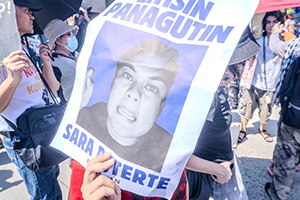
The impeachment trial of Vice President Sara Duterte opened this week amid heightened political tensions and renewed calls from progressive organizations for accountability, as prosecutors began presenting evidence while hundreds of demonstrators gathered outside the Senate demanding that the proceedings lead to justice not only for Duterte but also for other public officials accused of corruption.
Members of the Bantay Impeachment alliance, joined by the Bagong Alyansang Makabayan (BAYAN), Kilusang Mayo Uno (KMU), and other people's organizations, staged a protest outside the Senate, emphasizing that the impeachment trial should not be viewed simply as a political contest between the rival Marcos and Duterte camps. Instead, they described it as an important opportunity to expose corruption and affirm that no public official is above the law.
Inside the impeachment court, Senate President Francis "Chiz" Escudero formally presided over the proceedings as prosecutors outlined the charges against Duterte. They argued that evidence would establish the unauthorized use of confidential funds and other acts constituting betrayal of public trust and violations of the Constitution. Duterte's defense panel, meanwhile, maintained that the impeachment complaint was politically motivated and lacked sufficient legal basis.
The trial reached a significant milestone during its second day when the House prosecution panel presented its first witness, National Bureau of Investigation Cybercrime Division Senior Agent John Mark Calilung. His testimony focused on the fourth article of impeachment, which alleges that Duterte publicly threatened President Ferdinand Marcos Jr., First Lady Liza Araneta-Marcos, and former House Speaker Martin Romualdez during a live-streamed online briefing in November 2024.
Calilung testified on the NBI's cyber crime investigation and the preservation of digital evidence, including copies of the live-stream secured through coordination with Meta. Prosecutors argued that the video and related digital records are central to establishing the allegations before the impeachment court.
The proceedings were marked by repeated objections from Duterte's legal team, which sought to prevent Calilung from testifying on the grounds that he was not named in the original Articles of Impeachment. Prosecutors countered that the witness had been properly identified during pre-trial proceedings. Escudero denied the defense's motion, ruling that the prosecution was not confined solely to the summary evidence contained in the impeachment articles and allowing the witness to proceed.
Vice President Duterte did not attend the opening session despite being summoned, appearing only briefly at the Senate beforehand for a meeting with her legal team. Her absence drew criticism from progressive organizations, which argued that public officials facing serious allegations should personally answer before the impeachment court and the Filipino people.
Outside the Senate, demonstrators maintained that the impeachment case should serve as a warning to all corrupt officials. While demanding Duterte's conviction, BAYAN and KMU also stressed that accountability must extend beyond a single individual. They argued that corruption remains embedded within the country's political system and called for investigations into allegations involving other members of the ruling elite, including the Marcos administration. For the protesters, the trial represents not only a constitutional process but also a measure of the country's commitment to public accountability and democratic governance.