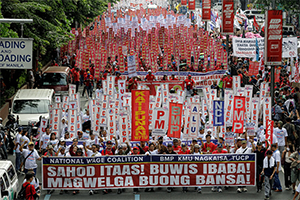
Thousands of workers and urban poor marched across the Philippines on May 1, International Labor Day, demanding a ₱1,200 national living wage and urgent government action against the country’s worsening economic crisis.
In Manila, workers led by Kilusang Mayo Uno and allied labor groups marched toward Mendiola under the banner of the National Wage Coalition. Protesters carried calls to “Raise wages! Lower taxes!” and condemned the administration of Ferdinand Marcos Jr. for failing to address soaring prices, stagnant wages, and rising unemployment.
According to organizers, as many as 30,000 workers, youth, church people, and professionals joined the mobilization in Manila alone. Parallel actions were also held in Baguio, Pampanga, Laguna, Cebu, Iloilo, Bacolod, Tacloban, Davao, and other provinces.
Workers said the current minimum wage covers only 36% to 54% of the actual daily needs of a Filipino family. Labor groups argued that a ₱1,200 living wage is necessary to cope with the spiraling costs of food, transportation, housing, medicine, and utilities.
The protests erupted as the country faces mounting economic distress. Research group IBON Foundation warned that the Philippines is entering a period of stagflation marked by slowing growth, high inflation, and worsening joblessness.
IBON reported that the Philippine economy grew by only 2.8% in the first quarter of 2026, the slowest among Southeast Asian economies. Inflation climbed to 7.2% in April, the second highest in the region, while unemployment reached 5.0% in March.
The group also pointed to rising fuel and electricity prices as major drivers of hardship. Gasoline prices remained at around ₱84 per liter and diesel prices at nearly ₱100 per liter by the end of April despite recent rollbacks. Electricity bills and water rates have likewise increased amid what critics described as weak regulation and corporate profiteering.
Food prices have also sharply risen. IBON noted that food inflation more than doubled from 2.7% in March to 6.1% in April. Rice, vegetables, fish, pork, and poultry all posted significant increases, further straining household budgets.
Labor groups accused the Marcos administration of responding with token measures while refusing to implement meaningful wage hikes or stronger price controls. Protesters criticized the government for merely “studying” proposals for a ₱200 legislated nationwide wage increase, even as it earlier approved an additional ₱200 daily allowance for soldiers and police.
“The burden of the crisis is being passed onto workers and poor families,” IBON said, noting that over 21 million vulnerable households are absorbing the impact of inflation and oil price shocks.
Agricultural workers also joined the May 1 protests, highlighting severe wage disparities in the countryside. In Eastern Visayas, farm workers reportedly earn only around ₱390 daily, far below the proposed living wage. Labor advocates also denounced contractualization, attacks on unions, and unsafe working conditions faced by workers in plantations and factories.
Police blocked sections of the Manila march with barricades, barbed wire, and fire trucks, preventing protesters from reaching Mendiola. Labor leaders condemned the deployment as repression and proof of the government’s disregard for workers’ democratic rights.
Beyond economic demands, sections of the mobilization also condemned foreign military intervention and rising geopolitical tensions. Protesters linked the global oil crisis and worsening poverty to ongoing US-led wars abroad and called for national industrialization, food security, and economic sovereignty.
Despite the repression and deteriorating conditions, labor groups vowed to continue organizing nationwide actions for higher wages, stronger union rights, and structural economic reforms.