Vol. VIII, No. 19 - October 15, 2026
While Filipino peasant families struggle to stretch their income to cover rising costs of food, electricity, transportation and other basic necessities, Marcos Jr. found time to attend the Formula 1 Singapore Grand Prix on October 12, 2026. For a president whose country is confronting rising prices, a weakening peso and the looming threat of a severe El Niño, the spectacle of luxury underscores the gulf between Malacañang and the everyday struggles of the Filipino masses.
This contradiction is also reflected in the economic and political system that the US-Marcos regime seeks to protect. While the administration promises that foreign investments will bring “prosperity” and “jobs”, the Philippines remains mired in a semicolonial and semifeudal system characterized by foreign monopoly control, landlordism and dependence on the export of raw materials and cheap labor. This system perpetuates landlessness, low wages, unemployment and widespread poverty, allowing foreign corporations and local ruling elites to profit from the country’s resources and the labor of its people.
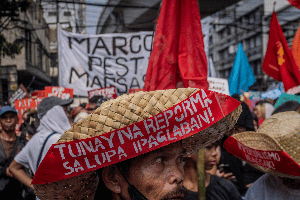
The contradiction is even clearer in Marcos’ insistence to hand out 4,000 acres of Philippine land (for free) to the US to build an AI hub for Pax Silica, a US-led initiative to secure supply chains for semiconductors, artificial intelligence and other strategic technologies. While US officials and Marcos Jr. himself presents this initiative as an opportunity for industrial development, farmers who traveled to Manila to demand land reform and protection of their livelihoods were met with police violence.
In October, peasant groups holding protest camps outside the Department of Environment and Natural Resources (DENR) and the Department of Agrarian Reform (DAR) faced police dispersals. On October 16, police dismantled the farmers’ camp at the DENR. On October 19, another police operation targeted their encampment at the DAR, where farmers were demanding genuine agrarian reform and an end to land grabbing and land conversion.
Across the countryside, resistance is growing against projects that seize agricultural lands and ancestral territories in the name of development. From the proposed economic and security hub in Tarlac and infrastructure projects under the Luzon Economic Corridor to mining, plantations, energy projects and tourism developments, vast areas are being opened up to corporate interests. Farmers and Indigenous peoples face displacement from their lands, while fisherfolk risk losing access to their fishing grounds. The Marcos regime’s promotion of Pax Silica must be viewed within this broader push to integrate the country into US-led strategic and commercial initiatives, even as the basic demands of rural communities remain unresolved.
Decades of government land reform programs have failed to resolve the problem of peasant landlessness. Farmers continue to toil on land they do not own, including rice fields, sugarcane lands, haciendas and plantations where landlord exploitation persists. Backbreaking work does not guarantee a decent livelihood. High production costs, low prices for agricultural products, price manipulation and mounting debts to banks and usurers keep farmers impoverished. The conversion of agricultural land for commercial and infrastructure projects further undermines food production, increases dependence on imports and contributes to the rising cost of rice, vegetables and other basic goods.
The threat of El Niño makes the situation even more urgent. Drought threatens harvests, reduces farmers' incomes and places further pressure on food supplies and prices. Farmers need irrigation, affordable inputs, crop insurance, subsidies and timely assistance. Rural communities need reliable access to water and protection from projects that undermine their land and livelihoods. Yet the regime's investment-driven development agenda offers no substitute for the structural reforms needed to ensure that the country can feed its people and protect its agricultural producers.
The Philippines cannot overcome its deep-seated poverty and underdevelopment by relying on foreign capital to determine the direction of its economy. Its semicolonial and semifeudal structure perpetuates dependence on raw-material exports, imported manufactured goods and the supply of cheap labor to foreign markets. Industrial projects that primarily serve external interests will not automatically resolve these problems. Genuine development requires transforming the country's economic foundations to serve the needs of its people.
Genuine agrarian reform and national industrialization are essential to this transformation. Agrarian reform must break the concentration of land ownership, place land in the hands of those who till it, and provide farmers with the resources and support needed to improve production and living standards. National industrialization must build domestic industries that process the country's resources, produce essential goods, create decent jobs and strengthen the domestic economy. Ultimately, the way out of the country's semicolonial and semifeudal crisis lies in the victory of the national democratic revolution primarily through protracted people’s war waged by the people’s army in the countrysides.