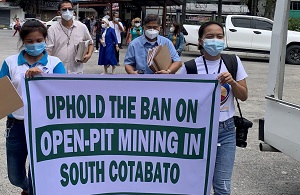
Indigenous lumad, Moros and local farmers in the communities of the Far South Mindanao region continue their resistance against land grabbing and plunder by US mining companies and the repression of the Manila government protecting these foreign mining interests.
In the last three decades, units of the Armed Forces of the Philippines have attacked and massacred the communities resisting the entry of open-pit mining operations in the region. The AFP’s 6th Infantry Division and Joint Task Force Central use US-supplied arms, bombs and military technology to attack the people in the communities targeted for the mining projects.
The region is rich in mineral resources. It holds copper deposits of up to 2.9 billion metric tons, iron deposits estimated at 2.5 million metric tons and gold at 2.275 million metric tons. In addition, there are significant deposits of silver, zinc, lead, manganese and other minerals. Along the borders of South Cotabato, Sarangani, Sultan Kudarat and Davao del Sur provinces lie the biggest gold deposit in Southeast Asia.
These mineral resources have attracted local and foreign capitalists to invest in mining projects in the region. Foremost is the Tampakan Gold-Copper Project which is the largest in the country and is valued at US$ 5.9 billion.
The local communities, however, have successfully fought and stopped its operations.
At least 17 mining companies operating in the region are 100% foreign-owned. Of these, eight are US-owned and control concessions covering a total of 53,081 hectares. Among the biggest are Providence Mining, Shamrock Metals, Kalamazoo Mining and Galactica Mining. Its operations are based in Australia and has interests in several Southeast Asian countries. Meanwhile, Providence Mining is an American multinational which operates large mines in Africa and North America.
The operations of seven of these eight companies are concentrated in the mountain areas of Sultan Kudarat and South Cotabato which are the ancestral lands of the Moros and the Dulangan-Manobo. These are covered with forests and watershed areas which support the vast agricultural lands of the region.