Manila Regional Trial Court Judge Thelma Bunyi-Medina dismissed on 16 December the 14-year old multiple murder charges against five National Democratic Front of the Philippines peace negotiations consultants Benito Tiamzon, Wilma Austria, Adelberto Silva, Vicente Ladlad and Satur Ocampo, farmer activists Norberto Murillo, Dario Tomada, Oscar Belleza and seven others. They were accused of being members of the New People’s Army and of committing mass murders in Leyte island, in central Philippines.
Judge Bunyi-Medina ruled that the prosecution failed to prove that the alleged victims were murdered, since there is neither documentary evidence of the death of the 15 alleged victims nor was there forensic evidence presented before the court. The prosecution was also not able to “scientifically prove” that the skeletons exhumed in 2006 in Hilongos, Leyte, were those of the alleged victims.
“The testimonies of the prosecution witnesses on the identities of the skeletal remains are full of inconsistencies, highly unbelievable, and clearly perjured,” the decision read. There were “numerous lapses in the handling, marking and chain of custody of the skeletal remains… further casting lingering doubts on their origin and identities.”
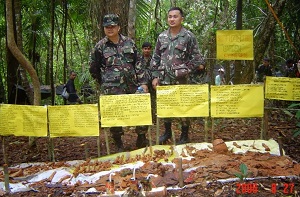
In 2000, security forces of the Manila government presented skeletons they dug out from an alleged mass grave in Baybay, Leyte. The skeletons were used as evidence in filing multiple murder charges against then Congressman Satur Ocampo and at least 60 other co-accused. The trial judge in Baybay dismissed the case for poor evidence.
Six years later in 2006, three of the skeletons appeared again, this time 40 kilometers away in Hilongos, Leyte, and presented again as murder victims in a new alleged mass grave. The media dubbed it “the case of the travelling skeletons”.
Taking note that many of the accused are involved with the GRP-NDFP peace negotiations, Judge Bunyi-Medina appealed for the resumption of the peace talks. She said, “This Court would not venture to analyze, reconcile or even discuss the conflicting ideological principles that precipitate hostilities between the government and the rebel movement. But this is just to manifest its sincere and ardent wish that their respective leaders will endeavor to go back to the negotiating table and eventually forge a long-lasting peace agreement which will be mutually beneficial to them.”
Reacting to the case’s dismissal, Satur Ocampo said, “The Manila court's ruling and its appeal for the resumption of formal peace negotiations are like a double breath of fresh air, and have been welcomed by peace advocates, the accused and their lawyers and supporters.”