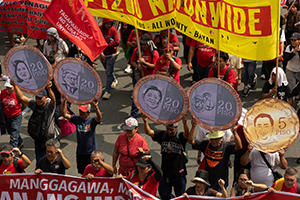
The recently approved P85 increase in the daily minimum wage has reignited debate among economists, labor groups, and policy analysts over whether raising workers' pay can improve living standards without fueling another round of inflation.
The wage adjustment was supposed to help restore workers' purchasing power after years of rising prices. It seeks to compensate for income eroded by inflation over the past two years and provide relief to millions of Filipino workers struggling with the soaring cost of food, transportation, fuel, and other basic necessities.
However, monetary authorities and economists argues that higher labor costs could lead businesses—particularly labor-intensive and service-oriented enterprises—to increase the prices of goods and services, potentially fueling another round of inflation. Labor groups and the IBON Foundation reject this view, contending that rising corporate profits, supply bottlenecks, and structural weaknesses in agriculture—not workers' wages—are the principal drivers of high prices.
According to IBON, the national average minimum wage of P510 per day covers only 39 percent of the estimated P1,312 family living wage, leaving millions of workers unable to meet even the basic needs of a family of five. The group also points out that real wages have steadily declined over the decades, with Filipino workers able to buy 21 percent less today than they could in 1989 because wage increases have consistently failed to keep pace with inflation.
IBON further contends that wage increases do not have to result in higher prices or business closures. Instead of passing additional labor costs on to consumers, it argues that many large corporations can absorb higher wages from their substantial profits. The group also maintains that increasing workers' incomes would stimulate the domestic economy by boosting consumer spending, which in turn benefits small and medium-sized enterprises through stronger local demand.
Progressive labor organizations likewise criticized the P85 wage increase as a "token adjustment" that remains far below what workers need to live decently. They argue that despite the increase, Filipino families continue to struggle with the relentless rise in the prices of food, fuel, housing, transportation, and other essential goods. For labor groups, the wage hike reflects the government's continued reluctance to address the widening gap between workers' earnings and the actual cost of living.
The debate also extends into economic theory. In Value, Price and Profit, Karl Marx argued that a general increase in wages does not necessarily lead to higher commodity prices. Instead, he maintained that wage increases primarily reduce the rate of profit while leaving the underlying value of commodities largely unchanged—a perspective frequently cited by labor advocates in challenging the claim that higher wages inevitably cause inflation.
As discussions continue, the wage increase has evolved into a broader debate over economic policy. Beyond the immediate issue of workers' pay, it has renewed calls for structural reforms to address high food prices, improve agricultural productivity and distribution, strengthen workers' purchasing power, and ensure that economic growth translates into a better standard of living for the country's working majority.