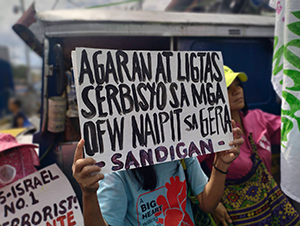
The escalating armed conflict between US-Israel and Iran is directly impacting 2.3 million Overseas Filipino Workers (OFWs) and other migrant workers working and residing in the Gulf countries (UAE, Saudi Arabia, Qatar, Kuwait, Oman, Bahrain). The war directly threatens the physical safety of OFWs in the Gulf countries in addition to the other countries in the region already involved in war, such as Palestine, Israel, Lebanon and Yemen. This is particularly acute for those OFWs situated near the 27 US and Israeli military bases and assets in the Middle East.
According to the latest data, 2025-26, 975,000 OFWs are in the UAE, 813,000 in Saudi Arabia, 250,000 in Qatar, 211,000 in Kuwait, 31,000 in Israel, and 1,400 in Iran. Many are long-term residents, business owners, students, and permanent fixtures in their adopted communities.
OFW remittances from West Asia totaled $6.48 billion in 2025 alone — roughly ₱380 billion flowing into Filipino households, buying food, paying school tuition, servicing mortgages, funding small businesses. Overall OFW remittances represented 7.3% of Philippine GDP in 2025.
Modern warfare presents more risk to the OFWs. Besides aircraft bombs, modern missiles and drones target infrastructure, airports, energy facilities and other vital assets. Even though both sides claim they target only military installations, the danger from missile interceptions, debris fallout, and misfires puts civilian facilities and populations at risk particularly in expatriate districts with dense populations.
A case in point: on the night of February 28, Mary Ann Velasquez, a 32-year caregiver in Israel, was killed by a bomb shrapnel while helping her elderly ward reach a bomb shelter.
It Migrant workers have limited protection and legal status under labor laws in West Asia. In times of crisis, many employers abandon their workers, withhold wages and confiscate passports and travel documents. In previous conflicts, migrant workers have often been the last to leave and the most vulnerable. It is even worse for the estimated 205,000 undocumented OFWs.
The conflict has severely affected aviation and travel in the region. Predictably, companies have altered their operations and rerouted flights due to airspace restrictions and security concerns, complicating the travel of migrant workers.
Evacuating over 2 million OFWs would be an extremely complicated task requiring massive air and sea transport, cooperation from the host governments and secure transit corridors. The current Philippine government, given its ongoing issues with corruption and incompetence, lacks resources, capacity and resolve to undertake these tasks.
Companies affected by the war are laying off workers. Migrant industrial and service workers as well as professionals are most affected. Those laid off are particularly vulnerable to forced labor, human trafficking and other labor violations especially under the kafala system. Undocumented workers, women (particularly pregnant and lactating mothers), young people, and persons with disabilities suffer the most.
As the war intensifies and spreads, the US-Marcos regime downplays the war and the accompanying chaos. It tells the Filipinos to remain calm and lowers the alert level in affected countries, even in Israel, where hundreds of OFWs have expressed a desire to return home. There is no clear, organized, and systematic plan for mass rescue, evacuation, and repatriation based on the number of OFWs wanting to return to the Philippines.
Embassies, consulates, and the Department of Migrant Workers (DMW) have been of accused of hiding funds that should be allocated to the Action Fund for OFWs. The Filipino people do not see, are not informed, and do not feel the so-called efforts of the Marcos Jr. regime regarding the war. #