Vol. VIII, No. 13 - July 15, 2026
The 2026 Marcos Jr’s official theme for Filipino-American Friendship Day was "80 years of shared history and sacrifice." Leading up to the event, a specialized commemorative logo took over high-profile displays like the SM Mall of Asia Globe, and official embassy statements heavily praised the legacy of World War II veterans. Because the holiday falls on the Fourth of July, U.S. Independence Day, its celebration in the United States by Filipino-Americans is uniquely layered. Yet, beneath the pageantry of this 80th anniversary of the 1946 Treaty of Manila lies a deeper political agenda: these festivities are carefully designed to promote the U.S.-Marcos administration’s narrative, masking ongoing U.S. control over the archipelago.
The July 4, 1946 Philippine independence was a historical hoax. It was a calculated transition from direct colonial rule to neocolonialism—a system where a country is independent on paper, but its economy, military, and foreign policy remain dictated by its former master.
The United States secured its grip on the newly "independent" republic through a combination of unequal treaties and legislative maneuvers. The most glaring was the Bell Trade Act of 1946. Standing amidst the literal rubble of World War II, a devastated Philippines was given a cruel ultimatum: the U.S. tied $620 million in desperately needed rehabilitation funds directly to the acceptance of the act. This forced the nation to grant "Parity Rights"—a humiliation requiring the amendment of the Philippine Constitution to give American corporations equal rights to exploit local natural resources and public utilities. Furthermore, duty-free U.S. imports strangled local industrialization, locking the country into a dependent cycle of exporting cheap raw materials while importing expensive American manufactured goods.
Beyond economic shackling, Washington ensured its military hegemony. The 1947 Military Bases Agreement granted the U.S. a 99-year lease on 23 installations, including massive enclaves like Clark Air Base and Subic Bay Naval Base, where Philippine laws did not apply. Paired with the Military Assistance Agreement, the United States kept the Armed Forces of the Philippines (AFP) fundamentally reliant on U.S. logistics and training—effectively outsourcing local defense to serve Washington’s geopolitical interests. This pseudo-independence intentionally bypassed the revolutionary masses, handing power to a collaborative haciendero and comprador ruling class. This elite oligarchic circle willingly safeguarded American interests in exchange for political backing and protection against domestic agrarian unrest, such as the Hukbo ng Bayan (People’s Army) rebellion.
Eight decades of U.S. neocolonial rule have cycled through thirteen puppet presidents—stretching from Manuel Roxas, Ferdinand Marcos Sr. to the current administration of Marcos Jr. Throughout this era, U.S. imperialism has systematically stunted the semi-colonial, semi-feudal Philippine economy. By keeping the nation underdeveloped and pre-industrial, Washington deliberately safeguards a system that favors the plunder of local resources, secures superprofits, and maintains a captive market for its own surplus products.
Historically, the U.S. used its Philippine bases as launching pads for its wars of aggression in Korea and Vietnam. That overt era of permanent presence seemingly ended on September 16, 1991, when the Philippine Senate rejected a base treaty extension, leading to the formal withdrawal of American troops by 1992.
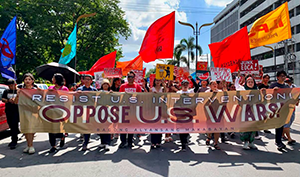
However, that historic victory was quickly sabotaged. The puppet U.S.-Benigno Aquino III regime circumvented the constitutional ban by classifying the Enhanced Defense Cooperation Agreement (EDCA) as a mere Executive Agreement rather than a treaty, effectively bypassing the Senate. Today, under the current U.S.-Marcos Jr. regime, this deception has expanded into a full-scale threat. The U.S. now maintains nine EDCA "Agreed Locations" embedded inside AFP camps. These sites are strategically positioned facing Taiwan and the West Philippine Sea—the primary flash points of potential armed conflict between China and the United States. Advanced U.S. missile systems capable of reaching mainland China are already deployed across the archipelago.
While the 1991 termination expelled permanently stationed troops, EDCA and VFA (Visiting Forces Agreement) successfully bypassed this through a "rotational" presence smokescreen. Under this guise, U.S. forces constantly cycle in and out of the country for joint exercises. Yet, while individual soldiers rotate, the permanent infrastructure they construct—warehouses, barracks, fuel depots, and runways—along with the heavy weapons they stockpile remain permanently on site. It is a functional, uninterrupted military presence hidden beneath a transient label.
The puppet Marcos Jr. regime is completely complicit in this theater of war, placing the Philippines directly on the front line of Washington's "first island chain" containment strategy against China. In doing so, it recklessly puts millions of Filipino lives in harm's way should a hot war erupt. Now more than ever, the Filipino people must be aroused, organized, and mobilized in the revolutionary struggle for true national and social liberation.